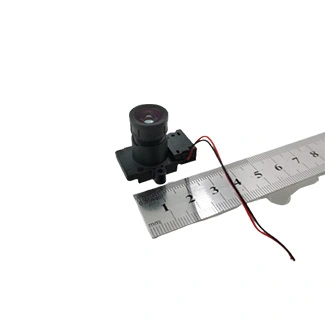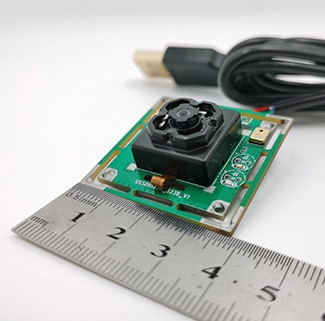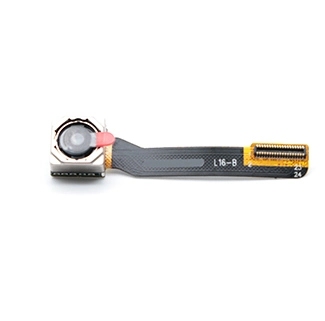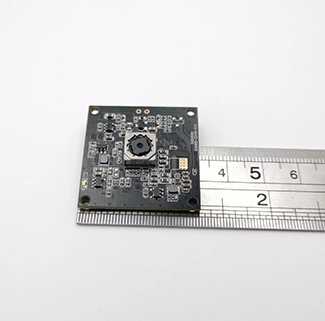
A miniature USB camera module may fit inside a very small enclosure, but its physical size alone does not determine whether it will capture the required image. Working distance, field of view, lens focal length, sensor size and focus setting must be matched to the target object and installation space.
For example, a camera designed to inspect a narrow pipe at a distance of 15 mm requires a different optical configuration from a camera monitoring an object 300 mm away. Using the same sensor and USB interface does not guarantee that both applications will achieve the required image coverage, focus and visible detail.
Working distance is the physical distance between the front of the camera lens and the target being imaged, while field of view is the area of the target that appears within the captured image.
This guide explains how these two parameters interact and what engineers should specify when selecting a miniature USB camera module for endoscopes, inspection tools, embedded terminals, robotics and other space-constrained imaging systems.
What Is the Working Distance of a Miniature USB Camera?
Camera working distance is the measured distance from the front of the lens to the target plane where the object must appear in acceptable focus.
Working distance is sometimes confused with focal length, but they describe different properties. Focal length is an optical characteristic of the lens, while working distance is determined by how the camera is positioned within the complete device.
The required working distance depends on the application. A cavity inspection tool may place the lens only a few millimeters from the target, while an embedded monitoring device may need to observe an object from several centimeters or more.
Important factors that affect the practical working distance include:
The distance between the camera lens and the enclosure window
The distance from the enclosure window to the target object
The lens focal length and focus setting
The acceptable sharpness range
The thickness and optical quality of any protective window
The required field of view at the target plane
A standard fixed-focus camera may be adjusted for medium-distance imaging or for objects extending toward infinity. That setting is not automatically suitable for an endoscope, borescope or close inspection tool. When the target is very close to the lens, the module usually requires a dedicated macro-focus configuration.
The focus should also be verified after the module is installed in the final enclosure. A protective glass or plastic window, an incorrect lens-to-window spacing or mechanical pressure on the PCB can change the effective image quality.
What Is Field of View in a Small USB Camera Module?
Field of view is the visible area captured by the camera at a specified working distance.
Field of view can be described in two ways:
Angular field of view: the viewing angle of the camera, normally expressed in degrees.
Physical field of view: the width and height of the target area visible at a particular working distance, normally expressed in millimeters.
Camera specifications may list horizontal, vertical and diagonal viewing angles. For engineering evaluation, the horizontal and vertical values are usually more useful than the diagonal value because they correspond directly to the width and height of the image.
The physical field of view can be approximated using the angular field of view and working distance:
Physical FOV ≈ 2 × Working Distance × tan(Angular FOV ÷ 2)
This relationship shows why the same camera lens covers a larger physical area when it is moved farther from the target. If the working distance is approximately doubled while the lens and sensor remain unchanged, the visible width and height will also increase by roughly the same proportion.
However, a larger visible area means that the available pixels are distributed across more of the target. A wider field of view may therefore reduce the number of pixels available for each small feature.
For example, capturing an entire mechanical cavity may be useful for navigation, but it may not provide enough pixel detail to inspect a tiny scratch or printed code. The field of view must be selected together with the resolution requirement rather than treated as an isolated lens specification.
How Working Distance and Field of View Affect Image Quality
Working distance and field of view determine how much of the target is visible, how large each feature appears and whether the target remains within the camera’s focus range.
Shorter Working Distance
Moving the camera closer to the object generally reduces the physical area visible in the image. The object appears larger, which can provide more pixels on small surface details.
A short working distance may be useful for:
Endoscope and cavity inspection
Close examination of components
Small barcode or text capture
Surface defect inspection
Dental, laboratory or scientific equipment prototypes
The main challenge is focus. A lens configured for distant objects may produce a blurred image when placed very close to the target. Short-distance applications may also have limited depth of field, making differences in target height more noticeable.
Longer Working Distance
Increasing the distance between the lens and the target expands the physical field of view. This can help the camera capture a larger machine area, container, document or workspace.
The trade-off is that small features occupy fewer pixels. If the system must identify fine details from a longer distance, it may require a higher-resolution sensor, a narrower-angle lens or a different mounting position.
Wider-Angle Lens
A wider-angle lens captures more of the scene without requiring the camera to move farther away. This is useful when the device has limited installation depth but must observe a relatively large area.
Very wide viewing angles can introduce additional considerations:
Greater barrel distortion near the image edges
Reduced detail per object across the wider scene
Possible edge softness or illumination falloff
More visible enclosure walls if the lens is recessed
Wide-angle selection should therefore be based on the required coverage and acceptable distortion, not simply on choosing the largest available FOV.
Narrower-Angle Lens
A narrower field of view captures a smaller target area but makes distant objects appear larger within the frame. It can be useful when the application needs more pixels on a defined inspection area or when image distortion must be controlled.
A narrow viewing angle may require additional installation depth. The mechanical enclosure must provide enough space to achieve the required field of view at the selected working distance.
Depth of Field
Depth of field is the distance range within which the target remains acceptably sharp without refocusing. It is especially important when the target surface is curved, when components have different heights or when the camera-to-object distance changes during use.
A camera can be sharply focused at one distance but still fail to keep the front and rear portions of a three-dimensional object clear. Lens aperture, focal length, focus distance, sensor resolution and the acceptable sharpness threshold all influence the usable depth of field.
Recommended Optical Configurations by Application
The correct miniature USB camera configuration should be selected according to the target size, required detail, available mounting distance and lighting environment.
| Application | Typical Optical Requirement | Recommended Configuration Direction | Key Validation Point |
|---|---|---|---|
| Cavity or endoscope inspection | Very short working distance and compact diameter | Macro-focused miniature lens with custom PCB or FPC | Confirm focus at the actual target distance inside the final enclosure |
| Pipe and equipment inspection | Wide scene coverage in a narrow space | Wide-angle lens with controlled distortion | Check whether enclosure walls or lighting components block the image |
| Surface defect inspection | High pixel density on a small target | Short or medium working distance with a narrower field of view | Calculate the number of pixels covering the smallest defect |
| Barcode or printed-text capture | Sharp focus and controlled geometric distortion | Low-distortion lens matched to code size and reading distance | Test the smallest code under real illumination and motion conditions |
| Compact robotics | Moderate field of view with changing object distances | Lens with sufficient depth of field and application-specific focus | Test image sharpness across the robot’s expected operating range |
| Embedded monitoring terminal | Stable coverage of a fixed target area | Fixed-focus lens selected for the installed working distance | Validate the camera after the enclosure window is installed |
The table provides a starting point rather than a universal specification. Two projects using the same miniature camera sensor may need different lenses because their target sizes, mounting distances and enclosure structures are different.
Resolution should also be evaluated together with the optical configuration. A 0.3MP camera can be suitable for basic navigation or visual observation, while applications requiring small-text recognition, measurement or detailed defect detection may need a higher-resolution USB camera module.
How to Specify a Custom Miniature USB Camera Module
A useful camera requirement should describe the physical target and installation conditions rather than requesting only a sensor model or viewing angle.
Before selecting a lens or requesting a sample, engineers and purchasing teams should provide the following information:
Available camera space: maximum PCB width, length, thickness and total lens height.
Target working distance: minimum, typical and maximum distance from the lens to the object.
Target size: the width and height of the area that must fit inside the image.
Smallest visible feature: the minimum defect, character, barcode or component detail that must be recognized.
Required field of view: physical coverage in millimeters is often more useful than requesting only an angle.
Depth variation: whether the target surface is flat or contains features at different distances.
Lighting conditions: brightness, light direction, reflections and whether visible or infrared illumination is used.
Host platform: Windows, Linux, Android or another embedded operating system.
USB configuration: cable length, connector type, cable direction and available power.
Image requirements: resolution, frame rate, format, color accuracy and acceptable distortion.
For projects with very limited installation space, CK Vision can evaluate a custom configuration based on its compact 0.3MP USB camera architecture, including PCB or FPC layout, M4 lens selection, focus distance, field of view, cable and connector requirements.
Customers who are still defining the complete system can also review the small USB camera module selection guide for additional information about sensor resolution, USB bandwidth, mechanical dimensions and host compatibility.
Optical selection should be followed by sample testing in the final device. Testing only the exposed camera module on a desktop may not reveal problems caused by the enclosure window, internal reflections, illumination position, USB cable routing or operating temperature.
When the selected sensor and lens produce acceptable geometry but require adjustments to exposure, white balance, color, sharpness or noise reduction, project-specific camera ISP tuning services may be used to optimize the image pipeline for the actual lighting environment.
Frequently Asked Questions
Does a wider field of view always provide a better image?
No. A wider field of view captures more of the scene, but each object occupies fewer pixels. It may also increase edge distortion. The correct FOV is the smallest coverage that still includes the complete target and necessary positioning tolerance.
What working distance should be used for an endoscope camera?
There is no universal endoscope working distance. It depends on the cavity size, target location, lens diameter, required field of view and enclosure design. The minimum, typical and maximum target distances should be specified before lens focusing.
Can a standard fixed-focus USB camera capture objects at very close range?
Not necessarily. A fixed-focus camera adjusted for medium or long distances may produce blurred images at close range. A macro-focus adjustment or different lens may be required.
How does working distance affect the visible target area?
With the same sensor and lens, increasing the working distance generally increases the physical width and height visible in the image. Moving the camera closer reduces the visible area and makes the target appear larger.
What is the difference between field of view and depth of field?
Field of view describes how much of the scene is visible across the image. Depth of field describes the range of object distances that remain acceptably sharp. A camera may have a wide FOV but a shallow depth of field.
Should buyers specify an FOV angle or a physical target size?
Providing the physical target width and height at a defined working distance is usually more useful. The camera supplier can then evaluate the sensor size and lens focal length needed to achieve the required angular and physical field of view.
Can the working distance and FOV be changed without modifying the USB interface?
Yes. In many projects, the lens and focus setting can be changed while the same USB 2.0 UVC electronics are retained. However, the new optical configuration must still be checked for mechanical fit, image quality and production consistency.
Conclusion
Working distance and field of view directly affect image coverage, focus and the number of pixels available for each target feature. A wider lens is not always better, and a smaller camera does not automatically support close-range imaging. The most reliable approach is to define the target size, mounting distance, smallest visible detail, available space and lighting conditions before selecting the lens and camera module.
For a custom miniature USB camera evaluation, send CK Vision your enclosure drawing, target working distance, required image coverage, host platform, cable requirements and expected production quantity.